


Copyright © 2022 Global Sky Business. All Rights Reserved.


BRAZILIAN BEEF
Brazilian Beef Production
Brazil is one of the most important beef producers in the world, the result of decades of investment in technology that not only increased productivity but also the quality of the Brazilian product, making it competitive and reaching the market of more than 150 countries.
USDA data points to a 7.7% drop last year and a 4.6% increase for 2022
In its report released last January on the world trade in livestock and poultry, the USDA pointed to a strong retraction in Brazilian beef production last year and a new recovery in the course of 2022.

According to the USDA, Brazil produced about 9.325 million tons of beef in 2021, equivalent to the worst volume of the last five years and meaning an annual retraction of 7.7%.
The previous forecast for last year reached 9.500 million tons. However, with the reports pointed out by Brazil from September of the detection of atypical bovine spongiform encephalopathy (BSE), China temporarily restricted beef imports, bringing down Brazilian slaughter in the fourth quarter. This impacted by almost 2% less the volume that already had a strong retraction.
However, with the issue resolved, strong demand from China should help stimulate beef production in Brazil in 2022. Estimated production for the current year is 9.750 million tons, an annual increase of 4.6%. Even so, if indeed achieved, it would mean the second lowest volume in six years.
Brazilian Beef Exports
Total beef exports in 2021 (including fresh and processed products) showed a 7% drop in volume and a 9% growth in revenue compared to the 2020 movement, according to the Brazilian Meatpacking Association (Abrafrigo). The entity compiled the data from the Ministry of Economy’s Foreign Trade Secretariat.
According to Abrafrigo, the country handled 1,867,594 tons in 2021 compared to 2,016,223 tons in 2020, a record year for exports. Thanks to the product’s price hike in international markets, however, revenue rose from $8.485 billion in 2020 to $9.236 billion in 2021.

The total movement of beef in the last month of the year reached 151,593 tonnes, against 168,155 tonnes in 2020, down 10%, according to the entity.
The revenue obtained was US$ 726.6 million, against US$ 741.2 million in 2020, a reduction of 2%.
Brazilian Beef for China
Although it reduced its imports from 1,182,673 tonnes in 2020 to 950,057 tonnes in 2021, China remains the biggest buyer of Brazilian beef, through the movement carried out by the city-state of Hong Kong and through purchases made by the mainland.
Abrafrigo reports that, last year, the United States became the second largest importer of the product, from acquisitions of 59,545 tons in 2020 to 148,177 tons in 2021, with an increase of 148.9% in handling. Chile remained in third position, going from 90,403 tonnes imported in 2020 to 110,626 tonnes in 2021 (+22.4%).

Even reducing its purchases by 42.5%, from 127,953 tonnes to 73,612 tonnes, Egypt ranked fourth. The United Arab Emirates increased its imports by 21.7%, from 40,861 tonnes in 2020 to 49,711 tonnes in 2021, ranking fifth. In sixth place, the Philippines went from 39,673 tonnes in 2020 to 46,349 tonnes in 2021 (+16.8%), while Saudi Arabia was seventh with a 0.5% drop in handling, which went from 41,067 tonnes in 2020. to 40,870 tons in 2021.
MAIN BREEDS OF BOVINE RAISED IN BRAZIL
The Aberdeen Angus breed is one of the best known in Brazil, with great prominence in the national and international beef markets. The quality of the meat is mainly responsible for this recognition, as it has an excellent marbling ability, in addition to a thick and uniform fat cover.
However, there are other factors that justify the breed's success in beef cattle. High fertility, precocity and calving ease ensure an excellent financial return to producers.
Precocity does not only refer to the fact that females start the reproductive cycle between 14 and 18 months, but also to their rapid growth and termination.
The breed, originally from Scotland, has quality meat, with 3mm to 6mm thick fat and a high degree of marbling, serving both the domestic and foreign markets. Although very well adapted to the climate of the gaucho pampa, it responds equally productively to the warmer regions of the country.
As if that were not enough, these animals are owls and docile, which facilitates handling inside the gate.
The Belgian Blue, or Belgian Blue, originated in Central Belgium from crossing local cattle breeds, such as Shorthorn and Charolais, in search of animals with greater musculature. Today, what most attracts attention in these animals is, without a doubt, their size.
They are up to 1.50 m tall, but can reach 1,300 kg, thanks to their main feature, conquered in 1960: double musculature, or muscular hypertrophy. Another curiosity of the breed is that it is the only one divided into two strains — one more focused on milk production, and the other, for cutting.
Despite the remarkable size, the breed is docile, has good physical mobility, high feed efficiency, calving ease, adaptability and short gestation period, compared to other bovine breeds. Belgian Blue makes up half of the Belgian herd and is increasingly accepted among South American breeders.
Brahman originated in the USA and is the result of crosses between important Zebu breeds, which began with a predominantly Guzerá Brazilian cattle, with the participation of Gir and Nellore. The selections aimed at the development of animals tolerant to humidity, heat, endo and ectoparasites and certain diseases.
Crossing the lines resulted in a bull breed that inherited the quality of the meat, the precocity of the calves and the easy adaptation to the Brazilian tropical climate, withstanding the coarser pastures well. They are animals that usually give great income to producers, both in meat production and reproduction.
Females are widely used in artificial insemination programs, embryo transfer and in vitro fertilization.
The Brangus is a breed resulting from crosses between Brahman and Aberdeen Angus, improved simultaneously in the USA, Brazil, Australia and Argentina. The selections aimed to increase the rusticity of European breeds and reduce vulnerability to parasites, with the contribution of zebu breeds.
Brangus also display sexual precocity, maternal skills and excellent carcass finish and meat marbling. They are animals widely used in confinement, as they adapt well and have a high weight gain.
The Caracu comes directly from ancient Iberian and Portuguese bull breeds and has been in Brazil since the colonial period. After four centuries of being raised under adverse conditions, such as strong weather, scarce food and various parasites, natural selection shaped rustic animals. Thus, its characteristics revert to good profitability for breeders.
It is certainly the European breed best adapted to the Brazilian tropical climate, presenting resistance to heat and to endo and ectoparasites. Their hooves also resist well to both hard and soggy soils, and females give birth easily.
The Caracu has lower food requirements, has dual aptitude and has been used in crosses to increase the rusticity of other breeds. Males cover in the field, which facilitates reproductive management.
The Charolais breed has French origins, specifically in the district of Charolles, where it was created to provide meat of excellent quality and palatability. Animals have also always been used as traction force, as they are muscular, large and heavy.
They have high carcass yield (both pasture and confinement), with little surface fat and high marbling. The breed is known for its precocity in crossbreeding and slaughtering.
Charolais is also widely used in industrial crossings. As the skin, horns, hooves, muzzle and mucous membranes are not pigmented, the breed is better adapted to temperate climates.
The Chianina is famous for its remarkable size, being one of the largest cattle breeds in the world in both size and weight. Bulls can be 1.80 m tall and reach 1,300 kg of live weight, and can gain an astonishing 1.2 kg of weight per day.
They are long-lived and fertile, and females give birth easily. In addition, they are precocious, being able to go to slaughter at 18 months, especially if they are well supplemented with a good feed for beef cattle. The quality of the meat is also noteworthy, as there is no fat between the fibers, just a little subcutaneous fat.
It originates in the Chiana Valley, in Italy, and arrived in São Paulo in the 1950s. Its excellent meat production capacity soon established interest in the breed in other Brazilian states.
Considered one of the oldest beef cattle breeds, Devon is of British origin. It is known for the superior marbling and high tenderness of the meat, which is also considered one of the best in the world.
Like the other British breeds, the Devon is well adapted to the cold climate of the South of the country, however, its rusticity allows for excellent creations in Mato Grosso do Sul and Bahia. The animals are precocious and docile, in addition to having maternal ability.
The breed arrived in Brazil in 1906, and the cross between Devon and Zebu originated the Bravon, another Brazilian bull breed.
Of Indian origin, Guzerá is another breed of beef cattle that is also apt for dairy production. It was the first zebu breed introduced in Brazil, in 1870, with the aim of dragging heavy coffee carts through the steep hills of Rio de Janeiro, in addition to providing meat and milk.
In India, it developed in fertile lands with a hot and humid climate, but today it is distributed in several Brazilian regions. However, it stands out for being the only breed that survived — and produced — during 5 consecutive years of drought in the Northeast region of Brazil (1978–1983), in addition to having faced other periods of historical drought.
It is the largest Indian zebu breed, and even the animals selected for milk production have a large size. Precocity, good carcass yield, rusticity and maternal ability are the main characteristics of Guzerá.
The breed originates in England, but the first specimens arrived in Brazil via Argentina and Uruguay. Their performance, combined with the practicality of handling, makes these animals very popular in several regions of the world, recognized as a basic breed.
They are large cattle and have a remarkable muscular structure. However, they are owls and quite docile in the field. They have high fertility, longevity and food efficiency, in addition to being rustic and presenting great adaptability to different production systems.
Herefords have excellent fattening capacity and carcass finishing, reaching the ideal weight for slaughter between 20 and 26 months, on average. The carcass fat is well distributed, which gives the meat a marbled appearance and a high quality, which guarantees prominence in the market.
This bull breed also takes its name from the province of origin, which is in the Southwest of France. Coming from the genetic improvement of the ancient Garoneza breed, it was used for animal traction; today, one of the characteristics that most attract the attention of breeders is the ease of calving.
The Limousin has been improved to be dual-purpose (meat and work) and therefore has a slightly larger body than other French breeds. Another highlight is that it also has great milk production.
Limousin's muscle fibers are finer than those of other cattle breeds, which provides high palatability and tenderness to the meat. In addition, it has low cholesterol levels compared to other breeds, meeting the demand of demanding consumers.
The Nellore is a bovine breed originating in India. These animals were brought to Brazil with the aim of improving native cattle and are the breed that receives the most selection, resulting in excellent production rates.
It is estimated that about 80% of the national beef herd is composed of Nelore or ringed cattle, being the predominant breed on farms in the central region of the country. These large animals achieve good development and are directed exclusively to meat production.
The appreciation they receive from ranchers is due to the rusticity of the breed, which, due to its many sweat glands, adapts well to the hot regions of Brazil. In addition, the coat is thick, which provides good protection from the attack of parasites – this means that the producer can have less expenses with medicines.
Females give birth easily, and calves, in turn, are born strong and healthy, which means that the loss is minimal. In addition, Nellore carcasses can reach 20 arrobas at 26 months, with a yield of 50 to 55% in a pasture diet. To top it off, they also tolerate dietary restrictions well.
Senepol has a recent history in Brazil, having arrived here in the 2000s. Even so, the country is already a reference in the genetic improvement of the breed, and the meat has been increasingly found in national slaughterhouses.
These animals have an accelerated growth and a short fattening cycle, which makes them ready for slaughter earlier. In addition, they have an excellent feed conversion ratio, and their calves have a higher weaning weight, being sold for prices above the replacement market average.
They are highly adaptable to any diet and tolerant of heat, humidity and parasites. They are also long-lived and have high reproductive performance. These characteristics make them more used in industrial crosses and with the aim of increasing the number of birth survivors on farms.
The Simmental originates in Switzerland, but the skills of these cattle soon made it economically very important, and today it is a cosmopolitan bull breed. Among the strains developed, the following stand out: Swiss, German, Austrian, Canadian, French, American and South African.
It has excellent milk and meat production and has productive, reproductive and growth precocity. In Brazil, Simmental is used in crosses, especially with Zebu cattle, providing excellent adaptability, maternal abilities and robustness.
The crossing of Simmental with Guzerá gave rise to the Simbrasil, a breed developed from 1976 onwards in Espírito Santo.
The Tabapuã emerged from the cross between the Guzerá, Nelore and Gir breeds and is known as the “Brazilian zebu”. The name refers to the place of origin of the breed, in the interior of the state of São Paulo. Among the most outstanding characteristics of Tabapuã are its precocity, easy fertilization and docility.
It is the first mocha zebu breed, and its genetic improvement has an economic criterion, since owls have advantages in housing and transport. Breeders seek to develop carcass yield, weight gain and precocity, to the detriment of racial characteristics, which are overvalued in other animals.
As beef cattle, Tabapuã has already demonstrated its potential in weight gain tests and, in dairy production, it has responded surprisingly to the stimuli of zootechnical selection.
The Wagyu breed is famous for the high degree of marbling and tenderness of the meat, characteristics hitherto unmatched. The excellent feed conversion and the greater capacity to deposit fat between the muscle fibers give the remarkable flavor to the meat, which is the most valued in the world.
The breed was developed in Japan, from crosses of Simmental, Ayshire and Brown Swiss and genetic improvements. The Wagyu breed was officially named in 1944.
There are records that Wagyu arrived in Brazil approximately 25 years ago, with the great objective of contributing to the genetic improvement of Brazilian beef. As it is a breed that requires specific management to achieve adequate marbling of the carcass, a specific protocol was developed in Brazil: prioritizing a balanced diet, adequate management and differentiated confinement time.
The breed is still little explored by Brazilian cattle ranchers, however, it is a good opportunity due to the quality of the meat and the market price.
Previous
Next

Prime Beef

Selection of Special Cuts
Previous
Next
ARGENTINE BEEF
Cattle slaughter during the fourth quarter of 2021 stood at levels slightly above 3.31 million head, a similar amount (0.0%) to the values corresponding to the third quarter of 2021, when also slaughtered approximately 3.31 million bovines. Compared to the fourth quarter of 2020, when about 3.64 million heads had been slaughtered, cattle slaughter showed significant falls (-9.2%). Of the 334 thousand heads less slaughtered in relation to the fourth quarter of 2020: 192.3 thousand were steers and young bulls and 6.4 thousand bulls, to which must be added the decrease of 43 thousand cows and more than 92 thousand heifers in the task.
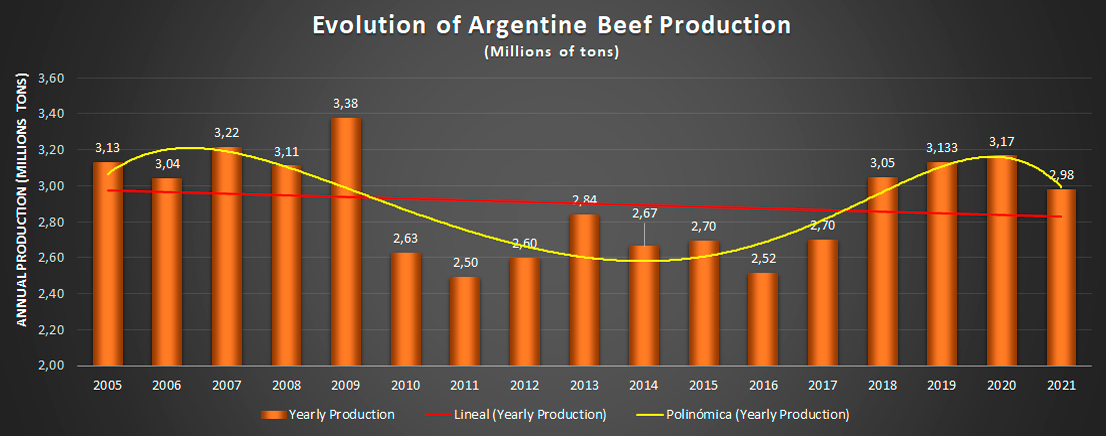
During the year 2021, bovine slaughter has been close to 13 million head, (-7.3%) below the values corresponding to the period January – December 2020, in which about 14 million head had been slaughtered. cattle. The significant decline observed in bovine slaughter, which is over a million heads, is explained by a drop in the slaughter of steers and heifers, of about 354 thousand heads, and of heifers, by about 400 thousand, which was accompanied by a lower slaughter of cows, less by about 257.5 thousand heads than the previous year, and also due to fewer bulls, about 14 thousand.
Throughout the fourth quarter of 2021, approximately 762.4 thousand tons of bone-in beef were produced; a slightly lower volume, (-1.5%), than that obtained during the third quarter of 2021, and, in addition, it was (-7.9%) lower than the volume of production processed during the fourth quarter of 2020, which had been close to 828 thousand tons. Comparing the volume of beef production in the fourth quarter of 2021 with that obtained throughout the same quarter of 2020, a year-on-year contraction of (-7.9%) is observed; in the same period of time, the fall registered in the number of slaughtered animals was (-9.2%). The improvement in the average weight of carcasses, which went from 227.2 to 230.4 kilograms, explains why production reacted 1.3 percentage points below the slaughter cut.
Beef production in the fourth quarter of 2021 showed slight falls in terms of its aggregate volume of production in relation to the third quarter of 2021, going from 774 thousand tons of bone-in beef equivalent to 762 thousand tons.
To round off this drop, 15.4 thousand tons less of steer and young bull meat were produced (-3.4%), 10.4 thousand tons less of beef (-8.0%); and 0.5 thousand tons less of bull meat (-3.2%); and in the opposite direction, 14.7 thousand tons more of heifer meat were produced, (+8.2%); leading to a quarterly drop in production of 11.6 thousand tons of beef, (-1.5%), comparing the fourth quarter of 2021 with the third quarter of the year.
When comparing the fourth quarter of 2021 with the same period in 2020, approximately 40.2 thousand tons less of steer meat and steers (-8.5%) were produced, 16.3 thousand tons less of heifer meat , (-7.7%); 7.1 thousand tons less of beef from cows (-5.6%), and 1.7 thousand tons less from beef from bulls, (-9.5%), resulting in a year-on-year drop in production close to 65, 2 thousand tons, (-7.9%), which went from about 828 thousand tons in the fourth quarter of 2020 to approximately 762 thousand tons in the fourth quarter of 2021.
ARGENTINE EXPORTS OF BOVINE MEAT
Argentine exports of beef accumulated over the last year, from March 2021 to February 2022, were located in volumes close to 708 thousand tons of bovine beef equivalent and 84 thousand tons of bovine bones; for a value close to 2,884 million dollars. In February 2022, foreign sales of bovine meat and bones were at significantly higher levels (+21.7%) than last January; and, they were slightly higher, (+2.5%), than those of February 2021, considering the volumes shipped in product weight tons (offals and viscera are not included).

In summary, shipments of chilled, frozen cuts, and processed meat corresponding to the month of February 2022 totaled about 40,001 tons of bovine meat product weight and approximately 6.9 thousand tons of bovine bones, for a value of approximately 266, 6 million dollars. The average FOB price per ton for the period in question was approximately US$8,900 for chilled boneless cuts; and over $5,740 for boneless frozen cuts. These prices have been significantly higher, (+33.4%), than those registered during the second month of 2021 for chilled cuts; and they were (+39.7%) higher than those of February 2021 in the case of frozen cuts. The average price of February 2022 increases slightly compared to January, (+1.8%), and increases significantly compared to February 2021, (+37.8%).
China absorbs more than 50% of Argentine beef exports
The People’s Republic of China was the main destination, in volume, for Argentine beef during the first two months of 2022 with approximately 63.0 thousand tons, followed by Israel, 6.43 thousand tons, and then by Chile, 3, 93 thousand tons. In terms of the value of foreign currency received, the main market during the period was China, which represents 63.5% of the total exported value of chilled, frozen and processed beef in the period, followed by Israel (9. 4%), and Germany (6.9%).

If shipments are compared in the first two months of 2022 with those corresponding to the period January to February 2021, they showed a varied behavior in relation to the levels of activity that had been registered a year ago: United States, the Netherlands and Germany show significant growth.
China, Israel and Italy exhibit moderate negative variations; while Chile, Brazil and Russia show falls of great magnitude in the volumes of Argentine meat demanded. The dependence on the Chinese market for Argentine beef exports has become decisive, and in the last month of February 2022, there were 34.5 thousand tons, which represented approximately 73.6% of shipments. Israel, with 2.6 thousand tons, became the second most relevant destination, in terms of volumes, in the month of February 2022.
Argentine beef exports fell by about 9.1 thousand tons when comparing the first two months of the last two years. Of this reduced volume, about 7.3 thousand tons correspond to lower shipments to China; and another 1.6 thousand tons correspond to Brazil and around 1.3 thousand to Chile, while the rest of the destinations as a whole accumulate an expansion close to one thousand tons.
MAIN BREEDS OF BOVINE RAISED IN ARGENTINA
Area of Origin: Northwest Scotland (Aberdeen County).
Introduction in Argentina: It was imported for the first time in 1879, it is the most abundant breed in Argentina due to its hardiness, meat production and climatic adaptability.
Characteristics: They are polled, the coat is black or red, mucous membranes are black or dark gray in the black A.A., and pink mucous membranes in the red A.A. used in meat production.
Area of Origin: South West England (Hereford County).
Introduction and diffusion in Argentina: The first importation of a breeder of this breed took place around the year 1860 with the “Niagara” bull. This breed is widely spread throughout the country's livestock area, but its highest concentration is located in the Patagonian region, mainly in the Patagonian foothills and even in Tierra del Fuego.
Characteristics: The dominant color is cherry red to abaya red, the face should be white, white extending to the chest, belly, groin and extremities, from the hock and knee down. The tail plume should be white. The mucous membranes are pink. The breed is highly sought after for its dosility, adaptability to cold climates and for the productivity of meat in great volume and quality. Varieties: Polled Hereford (Hereford polled).
Area of origin: Area of the United States, surrounding the Gulf of Mexico.
Diffusion in Argentina: In 1941 the first import is made, it is used as a pure breed or as crosses. Settled in northeastern Argentina.
Characteristics: Great muscular development, especially of the hindquarters. Large, pendulous ears. They can be polled or horned with horns similar to those of the Nelore and the most pendulous foreskin. The fur can be gray or red. Weights are similar to Nelore. It is very rustic, with great adaptation to tropical areas. Predominant race in the NEA.
Origin area: Oklahoma. USA
Introduction in Argentina: In 1954 the first genealogical records were opened.
Characteristics: It is a synthetic breed derived from the cross between Angus and Brahman, combining different proportions of blood to obtain the Brangus 1/2 varieties; Brangus 3/8; Brangus 5/8 (clarification, the fraction always refers to the percentage of Brahman blood, so for example ½ means that 50% of that variety of Brangus is Brahman blood), the coat is black or red and it is one of the meat breeds With the highest growth in the country in recent years, it has great adaptability to areas of high temperatures, this breed has a great performance in meat production in quantity and quality in hostile environments.
Origin area: USA
Characteristics: Synthetic breed originating from the cross between the Hereford and Brahman breeds, the Braford varieties are similar to the Brangus, their denomination is the same, that is, Braford 1/2, Braford 3/8, etc. The coat is similar to the Hereford. And like its original breeds, the Braford can be found polled or horned. This breed is widely accepted by producers throughout the Argentine coast, NEA AND NOA.
Area of origin: Southwest of France (Basque region).
Introduction and dissemination in Argentina: It only began to spread in the sixties. Today the main rodeos are found in the central provinces of the country, such as Córdoba, Buenos Aires and Santa Fe.
Characteristics: The coat is bay, lightening on the extremities and underside of the belly. the mucous membranes are pink, it is a breed that produces meat in volume par excellence, showing well-developed hindquarters, which is why it is widely used for crossbreeding, they can be polled or horned.
Distribution: It is spread throughout the Argentine Republic. This breed adapts well to different types of climate, rainfall, temperatures, soils, pastures, mountains, mountains, floodplains, etc.
Characteristics: The cow is of medium size (400 kg). High tail insertion which gives greater amplitude to the birth canal. The bull reaches 600 kg to 800 kg as an adult. He is meek and docile. He has all the fur. These bovines have the virtue of being very long-lived, possessing high rusticity and resistance to adverse conditions. Both polled and horned individuals can be found.
Previous
Next
AVAILABILITY:
Immediate
DELIVERY TERM:
45 days
INCOTERMS:
FOB / CIF
PRODUCT ORIGIN:
Brazil / Argentina
BUYER'S DOCUMENTS:
LOI & RWA
PAYMENT TERMS:
30% Advanced TT. 70% Remaining, L/C against Shipping Documents

We offer a complete range of commodities originating in South America.
Contacts
- Brazil: Av. Santos Dumont N°1883, Floor 5th, office 532/533, Aero Empresarial Building, Lauro de Freitas, Bahia, Brazil.
- Argentine: Tucuman 1946, Office N°04 - Córdoba, Argentina.
- info@globalskybusiness.com
- +55 71 98205 1492
Main Commodities
Subscribe
Follow our newsletter to stay updated about agency.